What Is a Reconsideration of Value (ROV)? A Complete Guide for Lenders
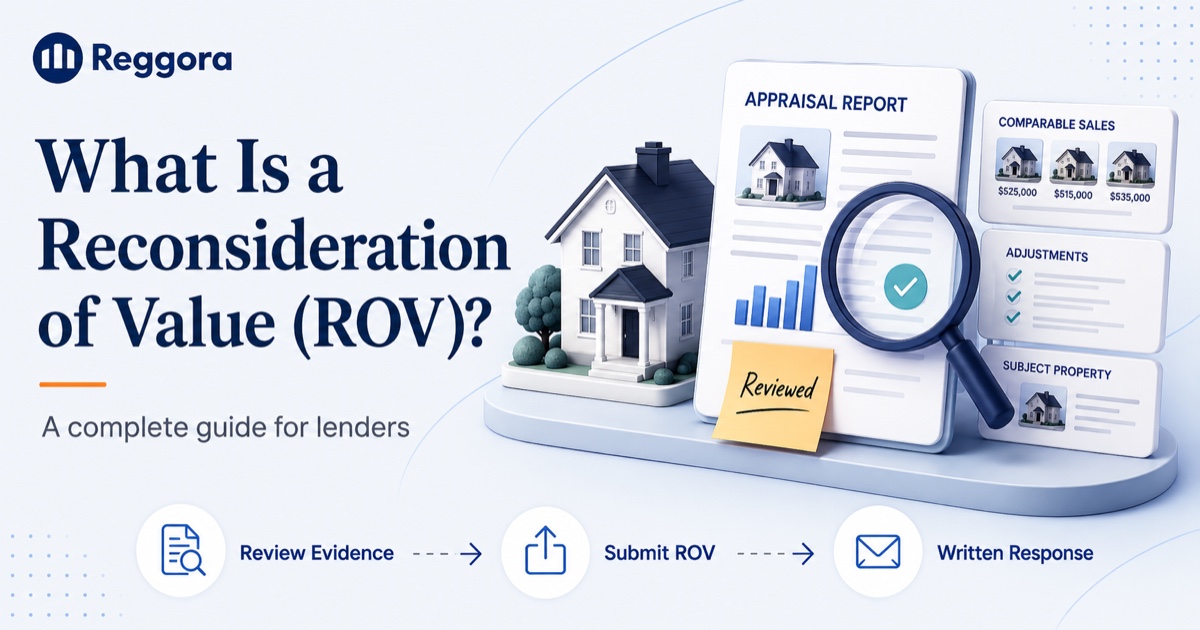
A reconsideration of value (ROV) is a formal request asking an appraiser to re-examine their opinion of value based on information the original report may have missed: overlooked comparable sales, factual errors about the property, or features the inspection didn't capture. The appraiser reviews the evidence and issues a written response; the value may change or stand.
The short answer: an ROV is the standard, regulated channel for disputing an appraisal. It goes through the lender (never directly to the appraiser), it runs on evidence rather than opinion, and under the aligned agency policies a borrower gets one per appraisal, so the request should be built carefully the first time.
Since May 2024, when Fannie Mae, Freddie Mac, and the FHA announced aligned ROV requirements, every lender is expected to run this process the same way: disclose it to borrowers, route requests to the appraiser with documentation, require a written response, and keep the full audit trail in the loan file. This guide covers how the process works step-by-step, what makes a request succeed, how an ROV differs from a second appraisal or field review, and what the standardized requirements demand of lenders.
Why the ROV process exists
Appraisals are professional opinions built from imperfect data, and sometimes they miss: a comparable sale that closed while the report was being written, a renovated kitchen the inspection notes glossed over, a square-footage error carried in from public records. Before 2024, how a borrower could challenge any of that varied lender to lender: some had clear processes, some had none, and requests could disappear into a loan file with no response.
Federal attention to appraisal bias turned that inconsistency into a policy problem. Research showing homes in minority neighborhoods were more likely to be undervalued made the ROV the borrower's formal remedy, and made a standardized, documented, fair-lending-reviewed process a requirement rather than a best practice.
How the ROV process works, step by step
- Disclosure. The lender tells the borrower about the ROV process twice, at application and again when the appraisal is delivered, so the right to request one is never a surprise.
- Request. The borrower (or the lender's own review team) submits the request through the lender with specific concerns and supporting evidence. Requests are accepted up until closing.
- Lender review. The lender screens the request, both to package it properly for the appraiser and to check for potential fair-lending concerns that need separate handling.
- Routed to the appraiser. The request goes to the original appraiser with the borrower's documentation attached, under a defined communication protocol and timeline.
- Written response. The appraiser addresses each point raised and either revises the report or explains why the original value stands.
- Documentation. The entire exchange (request, evidence, response, outcome) is retained in the loan file.
What makes a strong ROV request
Because the aligned policies contemplate a single borrower-initiated ROV per appraisal, the first request is the only request. The evidence that moves appraisers falls into three buckets:
- Factual corrections. Wrong gross living area, bed/bath count, lot size, garage capacity, or condition ratings that contradict the photos. These are the cleanest wins because they are verifiable.
- Better comparable sales. Closed sales the report didn't use that are more similar, more recent, or closer to the subject, with an explanation of why each one is more relevant than what the appraiser chose. FHA guidance caps borrower-submitted alternatives at five; fewer, stronger comps beat a long list.
- Missed improvements. Renovations, additions, or site features the inspection didn't capture, documented with permits, receipts, or photos.
What doesn't work: automated value estimates from consumer real estate sites, asking prices of active listings, the size of the down payment riding on the number, or the contract price itself. The appraiser is obligated to defend the analysis, not to meet a target.
ROV vs. second appraisal vs. field review
| Reconsideration of value | Second appraisal | Field review | |
|---|---|---|---|
| What it is | The original appraiser re-examines their own report against new evidence | A completely new appraisal by a different appraiser | A reviewer appraiser evaluates the original report's quality, usually with an exterior inspection |
| Who performs it | The original appraiser | A new appraiser | A review appraiser |
| When it's used | First channel for any value dispute with evidence behind it | Documented deficiencies in the original report, or program rules that require one | Lender QC, investor due diligence, or repurchase defense |
| Typical cost to borrower | None | A full appraisal fee (payer depends on circumstances) | None: a lender-side tool |
| Can it change the value? | Yes: the appraiser can revise the report | Yes: it produces a new opinion of value | Indirectly: it can trigger corrections or a new assignment |
What the standardized rules require of lenders
The aligned Fannie Mae, Freddie Mac, and FHA policies converted the ROV from a courtesy into a compliance obligation. In brief, lenders must disclose the process at application and appraisal delivery, accept and forward borrower requests with their documentation, enforce written appraiser responses under defined protocols, retain the full record in the loan file, and screen requests for fair-lending concerns. The requirements explainer walks through each obligation, and the bias-focused process guide covers the review indicators lenders should check before routing a request.
Put this guide to work: download the free ROV request template & checklist: the fill-in borrower letter, the evidence do's and don'ts, and the lender intake checklist, in one printable PDF.
Frequently asked questions
Who can request a reconsideration of value?
Borrowers and lenders. A borrower who believes the appraisal is inaccurate submits the request through their lender (never to the appraiser directly), and the lender forwards it with supporting documentation. Lenders' own underwriting or appraisal-review teams can also initiate an ROV when their quality-control checks surface issues. Either way, only the appraiser can change the opinion of value.
Can an ROV actually change the appraised value?
Yes, when the evidence warrants it. The appraiser re-examines the report against the new information and issues a written response; the value can go up, go down, or stay the same. An ROV is not a negotiation; it succeeds on overlooked comparable sales, factual errors, or missed property characteristics, not on the argument that the value is simply lower than the contract price.
How many ROV requests can a borrower make?
One per appraisal under the aligned GSE and FHA policies. That single shot is why the request should be assembled carefully the first time: verified property facts, the strongest available comparable sales (FHA guidance caps borrower-submitted alternatives at five), and a specific description of what the appraisal got wrong.
How long does a reconsideration of value take?
Typically days, not weeks, when the workflow is managed well; the standardized policies require lenders to establish defined protocols and communicate timelines rather than leaving requests open-ended. The practical drivers are how fast the lender packages and routes the request and how quickly the appraiser can turn a written response.
What evidence makes an ROV request successful?
Three categories carry weight: factual errors in the report (wrong square footage, bed/bath count, lot size, or condition rating), relevant comparable sales the appraiser did not use (ideally similar, nearby, and recent), and property improvements or features the inspection missed. Opinions about the market, automated estimates from consumer websites, and asking prices of active listings are weak evidence.
Is an ROV the same as ordering a second appraisal?
No. An ROV asks the original appraiser to re-examine their own report and is typically free to the borrower. A second appraisal is a new assignment by a different appraiser, allowed only in specific circumstances (such as documented deficiencies in the first report), and someone has to pay for it. The ROV is the standard first channel for a value dispute.
Does an ROV delay closing?
It adds days to the timeline, which is why the request should move as soon as the concern surfaces. The aligned policies require lenders to accept borrower ROV requests up until closing, but a request filed early in the appraisal-review window costs far less calendar time. Automated routing and deadline tracking keep the detour short.
What do ROVs have to do with appraisal bias?
The ROV is the formal channel for challenging a valuation a borrower believes is discriminatory, and the standardized requirements grew directly out of federal scrutiny of appraisal bias. Lenders must review ROV requests for potential fair-lending concerns and route suspected bias into their complaint and reporting processes, not just the valuation workflow.
Where Reggora fits
An ROV program is only as good as its plumbing: requests need intake, packaging, routing, deadline enforcement, and a complete audit trail, per loan, every time. Reggora automates that workflow end to end and pairs it with AI-powered appraisal review that catches report errors before the borrower ever has to dispute them. Talk to our team to see how lenders run compliant ROV processes without adding headcount.