What Is an Appraisal Management Company (AMC)? A Lender's Guide
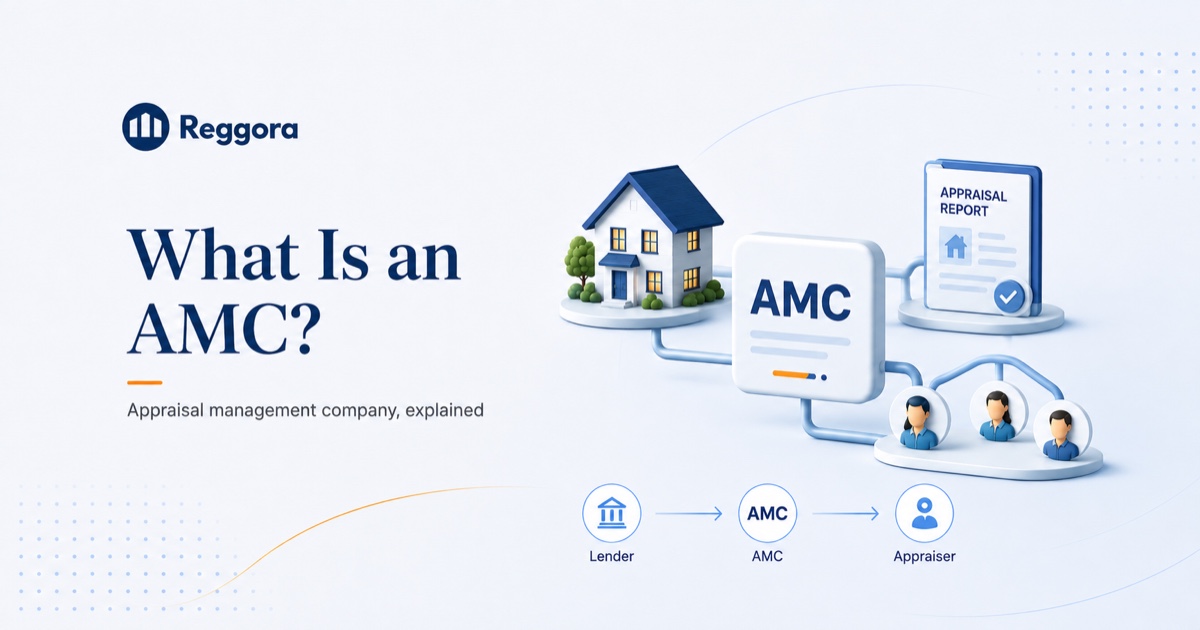
An appraisal management company (AMC) is a third-party firm that manages the appraisal process on a mortgage lender's behalf: it maintains the appraiser panel, assigns each order, handles scheduling and follow-up, reviews the completed report, and delivers it back to the lender, for a management fee built into every appraisal.
The short answer: an AMC is outsourcing. It exists to keep loan production separated from appraiser selection and to take coordination work off the lender's plate. That separation is required; the outsourcing is optional: lenders can achieve the same compliance in-house with a managed panel and the right controls.
This guide covers what AMCs actually do, why they became standard after the 2009-era independence rules, what they cost, how they're regulated, and how to decide between an AMC, running your own panel with appraisal management software, or a mix of both.
Why AMCs exist: appraiser independence
AMCs existed before the financial crisis, but they became the default after appraiser-pressure scandals produced the Home Valuation Code of Conduct (2009) and its successor, the GSEs' Appraiser Independence Requirements (AIR). The core rule: no one with a stake in the loan closing (loan officers above all) may select the appraiser or influence the value. Routing orders through a third party was the simplest way to prove that separation, and AMC market share surged.
What's often missed: AIR requires independence, not an AMC. A lender that separates duties internally (appraisal desk walled off from production, assignment by objective rules rather than human preference) is just as compliant. Modern platforms enforce that separation in software, with rules-based automated allocation that no loan officer can touch.
What an AMC does on every order
- Panel management. Recruits, vets, and maintains a roster of licensed appraisers, including coverage in markets the lender can't staff.
- Assignment. Selects an appraiser for each order: the independence buffer that keeps production out of the decision.
- Coordination. Schedules the inspection, chases status, and manages borrower and agent communication.
- Quality control. Reviews the completed report against USPAP and investor guidelines before delivery.
- Delivery and fees. Returns the report to the lender and administers the appraisal fee, keeping its management share.
The trade-offs lenders should price in
- Cost opacity. The AMC's fee is built into each appraisal and rarely itemized: part of every fee pays for coordination rather than the appraisal itself, and a lower appraiser share can mean the strongest appraisers deprioritize that work.
- Turn-time control. The lender sees status when the AMC reports it. When a file stalls, escalation runs through the middleman instead of directly to the appraiser.
- One-size processes. The AMC's workflow, product menu, and QC standards are its own. Lender-specific rules (overlays, preferred products like hybrids, custom review logic) depend on what the AMC supports.
- Accountability still lands on the lender. Regulators and investors hold the lender responsible for appraisal quality and independence regardless of who managed the order.
AMC vs. in-house panel with software
| AMC (outsourced) | In-house panel + software | |
|---|---|---|
| Who controls the panel | The AMC (its roster, its vetting) | The lender (direct relationships with chosen appraisers) |
| AIR compliance | Via the third-party buffer | Via separation of duties + rules-based automated assignment |
| Cost structure | Management fee inside every appraisal fee | Platform cost; the full fee otherwise goes to the appraiser |
| Turn-time leverage | Escalation through the AMC | Direct visibility and automated follow-up on every order |
| Data and reporting | What the AMC provides | Lender-owned: turn times, fees, vendor performance, pipeline |
| Best fit | Thin coverage markets; teams that want zero appraisal ops | Lenders treating appraisal as a performance lever |
These aren't mutually exclusive. A common pattern is a software-managed direct panel in core markets with AMC fulfillment where coverage is thin, run through one platform so workflow, status visibility, and data stay unified, and orders can even be allocated across AMCs by measured performance (turn time, revision rate, fee escalation rate).
How AMCs are regulated
Since Dodd-Frank, AMCs operate under federal minimum requirements (covering appraiser engagement standards, USPAP compliance review, and appraisal independence) and register with state appraisal boards, which add their own bonding, reporting, and fee rules. Lenders remain responsible for the appraisals they use, which is why AMC oversight (scorecards, audit rights, performance data) belongs in any outsourced model.
Frequently asked questions
What does an appraisal management company do?
An AMC acts as an intermediary between a mortgage lender and independent appraisers. It maintains the appraiser panel, assigns each order, manages scheduling and communication, performs a quality-control review of the completed report, and delivers it back to the lender. In exchange, a management fee is built into the appraisal fee on every order.
Is Reggora an AMC?
No. Reggora is appraisal management software and a nationwide appraiser marketplace, not an appraisal management company. Lenders use the Reggora platform to run appraisals in-house with their own panel, to route orders to AMCs, or both at once. The lender keeps control of vendor selection, allocation rules, and quality standards instead of outsourcing them.
Are lenders required to use an AMC?
No. The Appraiser Independence Requirements (AIR) require that loan-production staff cannot select or influence the appraiser, but independence can be achieved in-house with separation of duties and technology-enforced controls like rules-based automated assignment. Many lenders satisfy AIR with their own managed panel; the AMC is one way to comply, not the only way.
How do AMCs make money?
Through a management fee included in the appraisal fee collected on each order: the appraiser receives one portion and the AMC keeps the remainder for its services. Because the split is rarely itemized, lenders comparing costs should ask what share of the fee reaches the appraiser and what the administration actually costs per file.
What is the difference between an AMC and appraisal management software?
An AMC is a service: you send it orders and it manages appraisers on your behalf, for a fee built into each appraisal. Appraisal management software is a capability: your team keeps control of the panel, allocation rules, and quality standards, and the platform automates the coordination work an AMC would otherwise charge for.
Who regulates appraisal management companies?
AMCs register with state appraisal boards and operate under federal minimum requirements established after Dodd-Frank, covering appraiser engagement, USPAP compliance review, and appraisal independence. States layer their own registration, bonding, and reporting rules on top, so oversight varies by state.
Can a lender use both an AMC and its own appraiser panel?
Yes. It's a common pattern: a software-managed direct panel in core markets, with AMC fulfillment where coverage is thin, run through one platform so workflow, status visibility, and data stay unified. Modern platforms can also allocate orders across multiple AMCs based on measured performance like turn time and revision rate.
Where Reggora fits
Reggora is not an AMC; it's the platform lenders use to run appraisals on their own terms: a nationwide appraiser marketplace with automated, AIR-safe allocation, AI-powered review, payments, and full pipeline visibility, with AMC routing built in for lenders who run a mixed model. Lenders on the platform report 35% faster turn times and about $250 saved per loan. Start with the appraisal management software buyer's guide or see the platform live.